Fine Tuning vs RAG: When to Build Custom LLMs in 2026
Most teams frame this as a fight. It is not. Fine tuning changes how a model behaves. RAG changes what it knows. Picking the wrong one for your problem…
Read
Custom AI and LLM systems, not API wrappers. We build retrieval pipelines, fine tuned models and tool using agents that hold up under production load, with an evaluation harness so you can see accuracy before you commit budget. Most engagements start by measuring what your current process actually gets right.
See detailsInvoices, contracts and claims turned into structured data you can trust. We benchmark extraction accuracy per field and cost per thousand pages against your own documents before proposing an approach, and ship with a confidence threshold that routes uncertain cases to a human rather than guessing.
See detailsWeb and mobile products built to be maintained, not just launched. Scalable platforms, APIs and data layers on stacks chosen for the problem rather than for the CV, with performance budgets agreed before the first sprint and measured after every release.
See detailsSenior engineers who work inside your setup, not alongside it. Specialists matched to your stack, seniority level and time zone, working in your environment and your backlog with full ownership of assigned tasks, so delivery velocity stops depending on any one person staying.
See detailsHow we build the systems we ship. Architectures, benchmarks and postmortems from production work.
Most teams frame this as a fight. It is not. Fine tuning changes how a model behaves. RAG changes what it knows. Picking the wrong one for your problem…
Feed a top model a 200 page compliance manual and ask about Section 14.3. You get a confident, well structured answer that is partly fabricated. Bigger…
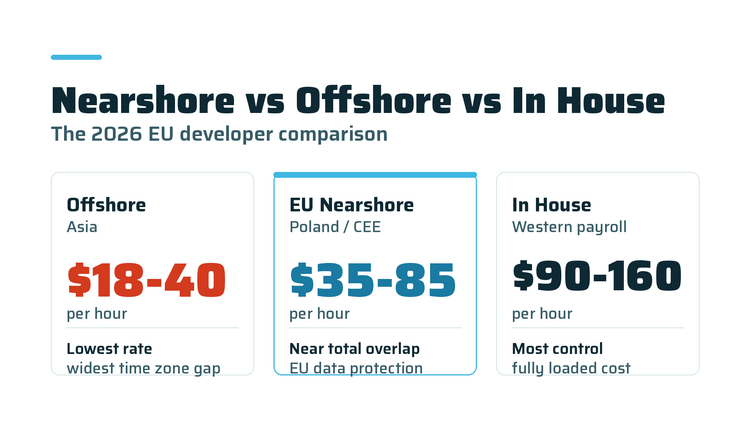
Every engineering leader scaling a team in 2026 makes the same decision. Hire in house, send the work offshore to Asia, or build a nearshore team inside…
What people ask before the first call, answered without the sales layer.
It builds software around machine learning instead of reselling access to someone else's model. In practice that is three jobs at once: choosing and training the models, building the retrieval, evaluation and data pipelines around them, and wiring the result into the systems a business already runs on. Oligamy Software does all three, and most engagements start by measuring what the current process gets right today, because that number decides whether a model is an improvement or just a change.
An automation agency connects no code tools to each other. That is a real service and it solves real problems, but it is not this one. We get hired when the workflow has to survive an audit, a load spike or a regulator, and a wrong output is an incident rather than an inconvenience. That means owning the model, the evaluation suite and the code, rather than the connectors between other people's products.
It depends on how much of the problem is already understood, which is why we prefer to measure before quoting. We price against a unit of work rather than a headcount, so the question becomes cost per thousand pages, per claim or per ticket, compared against what the same work costs today. That comparison is also the honest way to find out that a project is not worth building, which happens.
Yes. Retrieval augmented generation over large document sets, fine tuned models where the problem is how a model behaves rather than what it knows, and tool using agents with explicit limits on what they are allowed to execute. Systems ship with a confidence threshold that routes uncertain cases to a human instead of guessing, and with a log of what was decided and why.
Oligamy Software is based in Gdansk, Poland, with more than 50 engineers, and works with clients internationally. Engineers work inside your environment and your backlog, matched to your stack, seniority level and time zone, rather than handing work over a wall at the end of the day.